

Showing posts with label Beer History. Show all posts
Showing posts with label Beer History. Show all posts
Wednesday, May 10, 2017

Wednesday, March 22, 2017

Friday, February 24, 2017
The Comic Book Story of Beer: The World's Favorite Beverage from 7000 BC to Today's Craft Brewing Revolution

A full-color, lushly illustrated graphic novel that recounts the many-layered past and present of beer through dynamic pairings of pictures and meticulously researched insight into the history of the world's favorite brew.

Friday, February 10, 2017
Beer & Brewing Museum

The Museum of Beer & Brewing is a not-for-profit organization working to build a museum (both virtual and physical) to preserve and display the proud history of beer and brewing throughout the world; the science, art, architecture and traditions that have shaped our culture for thousands of years.
Source: Here


Wednesday, February 8, 2017
Monday, February 6, 2017
Thursday, February 2, 2017
The Juniper Mystery
When I started looking at farmhouse ale back in 2010, one of the first things that struck me was that nearly everyone seemed to be using juniper. That was unexpected, since the beer literature generally has very little to say about juniper. Now, six years later, I'm beginning to realize that the international beer community has somehow managed to miss a huge story here.
 For example, the Oxford Companion to Beer says juniper is used in the Nordic countries, and particularly in sahti. And that it's used in gin. That's pretty much it. The most comprehensive overview of additives in traditional brewing, Karl-Ernst Behre's 1999 paper[15], mentions that juniper has been used in Estonia. Again, that's it. Nils von Hofsten's jaw-droppingly erudite book on herbs in beer from 1960 briefly mentions juniper use in Sweden, but that's it[18]. And so on.
Rest of the article: Here
 For example, the Oxford Companion to Beer says juniper is used in the Nordic countries, and particularly in sahti. And that it's used in gin. That's pretty much it. The most comprehensive overview of additives in traditional brewing, Karl-Ernst Behre's 1999 paper[15], mentions that juniper has been used in Estonia. Again, that's it. Nils von Hofsten's jaw-droppingly erudite book on herbs in beer from 1960 briefly mentions juniper use in Sweden, but that's it[18]. And so on.
Rest of the article: Here
Sunday, September 4, 2016
The Search for God and Guinness: A Biography of the Beer that Changed the World
The history of Guinness, one of the world’s most famous brands, reveals the noble heights and generosity of a great family and an innovative business.
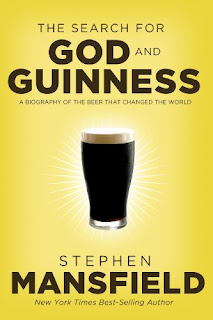 It began in Ireland in the mid 1700s. The water in Ireland, indeed throughout Europe, was famously undrinkable, and the gin and whiskey that took its place devastated civil society. It was a disease ridden, starvation-plagued, alcoholic age, and Christians like Arthur Guinness—as well as monks and even evangelical churches—brewed beer that provided a healthier alternative to the poisonous waters and liquors of the times. This is where the Guinness tale began. Now, 250 years and over 150 countries later, Guinness is a global brand, one of the most consumed beverages in the world. The tale that unfolds during those two and a half centuries has power to thrill audiences today: the generational drama, business adventure, industrial and social reforms, deep-felt faith, and the noble beer itself.
"Frothy, delicious, intoxicating and nutritious! No, I'm not talking about Guinness Stout—I'm talking about Stephen Mansfield's fabulous new book...The amazing and true story of how the Guinness family used its wealth and influence to touch millions is an absolute inspiration." — Eric Metaxas, New York Times best-selling author
"It's a rare brew that takes faith, philanthropy and the frothy head of freshly-poured Guinness and combines them into such an inspiriting narrative. Cheers to brewmaster Stephen Mansfield! And cheers to you, the reader! You're in for a treat." — R. Emmett Tyrrell Jr., Founder and editor-in-chief of The American Spectator
You can order the book here:
The Search for God and Guinness: A Biography of the Beer that Changed the World
Guinness Clone Recipe - Here
 It began in Ireland in the mid 1700s. The water in Ireland, indeed throughout Europe, was famously undrinkable, and the gin and whiskey that took its place devastated civil society. It was a disease ridden, starvation-plagued, alcoholic age, and Christians like Arthur Guinness—as well as monks and even evangelical churches—brewed beer that provided a healthier alternative to the poisonous waters and liquors of the times. This is where the Guinness tale began. Now, 250 years and over 150 countries later, Guinness is a global brand, one of the most consumed beverages in the world. The tale that unfolds during those two and a half centuries has power to thrill audiences today: the generational drama, business adventure, industrial and social reforms, deep-felt faith, and the noble beer itself.
"Frothy, delicious, intoxicating and nutritious! No, I'm not talking about Guinness Stout—I'm talking about Stephen Mansfield's fabulous new book...The amazing and true story of how the Guinness family used its wealth and influence to touch millions is an absolute inspiration." — Eric Metaxas, New York Times best-selling author
"It's a rare brew that takes faith, philanthropy and the frothy head of freshly-poured Guinness and combines them into such an inspiriting narrative. Cheers to brewmaster Stephen Mansfield! And cheers to you, the reader! You're in for a treat." — R. Emmett Tyrrell Jr., Founder and editor-in-chief of The American Spectator
You can order the book here:
The Search for God and Guinness: A Biography of the Beer that Changed the World
Guinness Clone Recipe - Here
Monday, August 29, 2016
Beer Barrels: from Roman Times to the Present Day

Metal beer containers have now almost completely replaced timber ones, stainless steel being the most widely used material. The influences on container design, as well as the manufacture and operation of them, are discussed.
Source:
By Eric R. Partington
European Consultant to the Nickel Institute
Reprinted from the ENCYCLOPAEDIA OF FOOD SCIENCE AND NUTRITION.
More good information here at Wikipedia
Sunday, August 28, 2016
Subscribe to:
Posts (Atom)